Episode 15, "Circe," takes place around midnight (one schema
has it ending at 12 AM, the other starting then). It is the
witching hour. At the outset there are echoes of Goethe's
Walpurgisnacht and Flaubert's vision-tormented St. Anthony.
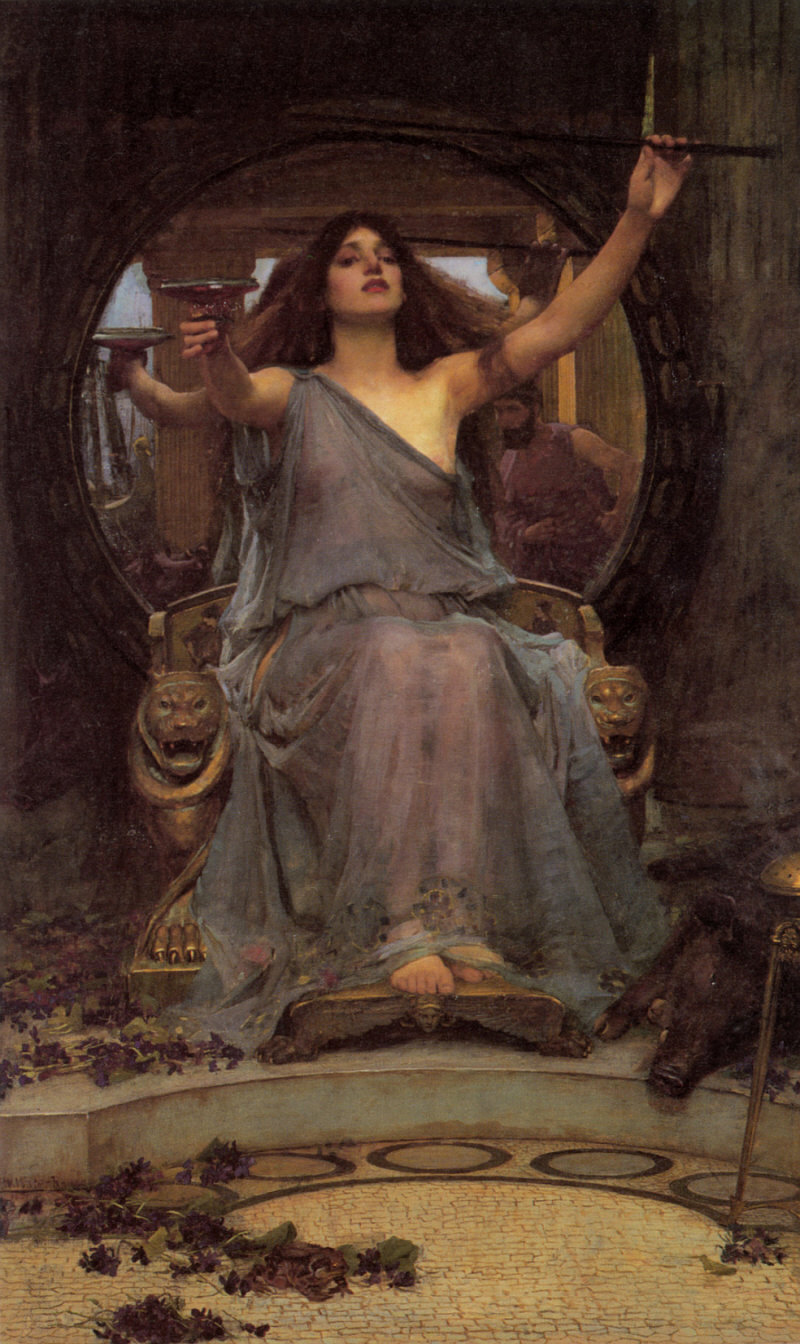
Later, Homer's story of an enchantress turning men into
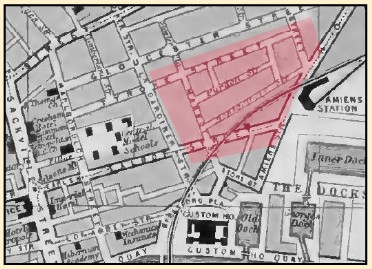
animals dominates. The scene is what Dubliners of Joyce's time
called the Monto—a large, poor, and dangerous red-light
district east of O'Connell Street. After the seemingly
chaotic, reality-bending proliferation of narrative voices in
Oxen of the Sun, Circe offers a series of wildly
dramatic scenes, some of them more or less actual, others
clearly hallucinatory. It is not always easy to tell the
difference, or to say who may be hallucinating. The chapter is
not difficult to read, as Oxen was, but it perpetuates
Oxen's kaleidoscopic variety and its assault on
traditional narration—the action being presented now as
dramatic dialogue with stage directions. Astonishing effects
share the stage: quasi-Freudian psychoanalysis (minus the
analyst), hilarious comedy, matter-of-fact sex changes,
nightmarish apparitions, grandiose wish-fulfillments and
public disgraces. On every page—and there are many, filling
nearly a quarter of the novel—phrases and preoccupations from
earlier chapters reappear, creating a sense that all of June
16 is being recycled, tumbling about in a vast phantasmagoric
washing machine.
Book 10 of the Odyssey tells how men sent out to
investigate a palace on a strange island find, as they
approach, mountain wolves and lions who act like friendly
dogs. The goddess Circe invites the men into her home and
gives them a drugged drink that turns them into pigs.
Eurylochus, who has suspiciously remained outside, runs back
to tell the others, and Odysseus goes to rescue his men. On
the way, the god Hermes warns him not to attack Circe but to
accept her offer of a drink, because a plant called moly will
counteract its effect. Odysseus accepts the plant from Hermes
and does as he advises, entering the house, drinking the
potion, threatening Circe when she thinks to enchant him, and
agreeing to her suggestion that they have sex, but only after
extracting a promise "that she will not plot further harm for
you— / or while you have your clothes off, she may hurt you, /
unmanning you" (299-301, trans. Wilson). After this
trust-building exercise, Odysseus persuades her to free his
men. He goes back to his ship and, over Eurylochus's
objection, leads the rest of the crew to the dreaded palace,
where for one year all the men feast and drink and recuperate.
Crucial elements of this story make it into Joyce's chapter.
Animal images are everywhere in Circe, and sometimes
there are clear echoes of the Greeks turning into beasts.
Perhaps the most overt comes when Zoe beckons Bloom into Bella
Cohen's brothel:
(He hesitates amid scents, music, temptations.
She leads him towards the steps, drawing him by the odour of
her armpits, the vice of her painted eyes, the rustle of her
slip in whose sinuous folds lurks the lion reek of all the
male brutes that have possessed her.)
THE MALE BRUTES
(Exhaling sulphur of rut and dung and ramping in their
loosebox, faintly roaring, their drugged heads swaying to
and fro.) Good!
Like Odysseus going in to rescue his men, Bloom goes in after
Stephen, whom he has followed from Holles Street. Inside, he
is repeatedly threatened with "unmanning," most violently when
he becomes an enslaved, degraded female prostitute at the
mercy of the aggressive Bello. Bloom's eventual recovery of
sobriety, fortitude, and masculine agency recall Odysseus's
escape from danger. At the end of the chapter he heroically
rescues Stephen from exploitation and violence and leads him
away from the nightmarish district.
Many other literary works featuring hallucinatory magic,
dramatic hyperrealism, and perilous sexuality inform the
matter and manner of Joyce's chapter. A footnote in Gifford's
volume of annotations supplies a partial list: Flaubert's The
Temptation of Saint Anthony; Goethe's Faust;
Hauptmann's The Assumption of Hannele; Ibsen's Ghosts;
Strindberg's The Ghost Sonata and The Dream Play;
Sacher-Masoch's Venus in Furs; Krafft-Ebing's Psychopathia
Sexualis. Havelock Ellis's Studies in the Psychology
of Sex almost certainly belongs on this list.
Circe represents the fulfillment of one of Joyce's
most cherished aesthetic ideas: that literary art achieves its
most profound effects in drama. In the early essay "Drama and
Life" (1900) he explored the notion that great dramatic works
get at the most enduring truths of human existence. In part 5
of A Portrait of the Artist (1904-16) he had Stephen
Dedalus elevate drama over lyric and epic by observing that
the dramatic artist transcends his own emotional states,
projecting his personality so self-effacingly into his
characters that they take on "a proper and intangible esthetic
life." In Exiles (1914-18) he produced an Ibsen-like
stage play incorporating some of the concerns that would
dominate Ulysses. In Scylla and Charybdis
(1919) he had Stephen discuss Shakespeare as the archetypal
literary creator. Circe (1920-21) can be seen as the
fruition of all these years of thinking about drama as a
vehicle for high literary aspirations. It is a spectacular
achievement.
Readers can discover other features of this stunning closet
drama on their own, but one final introductory observation may
be helpful. At many points in Ulysses the phrase "a
retrospective arrangement" recurs. Among other applications,
the expression seems relevant to the way most chapters in the
book build upon, and require precise recall of, earlier ones,
explicitly alluding to things mentioned much earlier and
forcing readers to remember when they first heard them. Circe
takes this practice to dizzying extremes. For its best
students, it offers a kind of comprehensive final exam:
underline every phrase on page 1 that you have encountered
elsewhere in the novel; in the margin, identify the chapter in
which each occurs and describe the context and significance;
repeat for the next 180 pages.
In their brief introduction to the chapter, Slote, Mamigonian,
and Turner quote John Rickard's response to this feature of
Circe:
"virtually every notable occurrence, every word of significance
in Ulysses is 'remembered' by the text and becomes available to
the characters—not only to the character who originally
experienced the event, but [also] to other characters and to the
various, often limited, narrative voices in the novel. Thus, the
text of
Ulysses becomes a sort of Akasic memory 'of all
that ever anywhere wherever was'" (
Joyce's Book of Memory,
108). Rickard offers the analogy of Akasic memory in the
speculative, guarded spirit appropriate to all discussions of
Theosophical beliefs in
Ulysses ("One could even argue
that this model of memory underlies a complex textual memory in
the novel..."). No matter whether a Universal Memory exists in
nature: it offers one way of describing a striking literary
effect.
The sense of retrospective totality achieved by this recycling
of old elements does not end with the last page of
Circe.
Ithaca builds on it by subjecting countless details
encountered earlier in the book to a catechetical logical
examination that feels comprehensive, as if they are
contributing to some vast Aquinian summa. At the opposite
stylistic extreme—concrete, emotional, associative—
Penelope
achieves a similiar feeling of wholeness by revisiting the day's
events through the swirling and intersecting mental orbits of
one woman's reflections. The sense of totality begins in the
vast historical sweep of
Oxen of the Sun, and with the
exception of
Eumaeus persists to the end of the novel.
Ulysses
is not simply the record of one day. It is an encapsulation of
human existence that teaches its readers how to hold it in
memory, a unified interpenetrating whole.